
Daniel 8:1-14, Part 3


Daniel’s Vision: Ram & Goat Part 3
Guest (Male): Holy Scriptures and Israel is a ministry designed to share with the Jewish people the good news of the Lord Jesus Yeshua the Messiah and to instruct Christians on the Jewish roots of their faith. And now teaching God's word from a Hebrew Messianic perspective here is Gideon Levitan.
Gideon Levytam: The study of Daniel chapter 8 in Genesis chapter 15 in verse 5 God makes a covenant with Abraham, the father of the nation of Israel. God made a covenant with Abraham and notice what God says to Abraham in verse 5. And he brought him forth abroad and he said look now toward heaven and tell the stars if thou are able to number them. And he said unto him so shall thy seed be. Abraham looked towards the stars. Can you number the stars? That's how many your descendants are going to be. Now of course I know that many time we take the stars of heaven to represent the heavenly company or the believers from among the Gentiles.
And we look at the sand of the sea because he told him can you number the sand of the sea. We usually represent the Jewish people, the nation of Israel. But in Antiochus coming to the pleasant land and going against the host of heaven this in the pleasant land when it's coming to the time that Antiochus reign has a reference to the Jewish people, to the people of Israel. Now look with me to another interesting verse in Exodus chapter 12 now. Again we are looking at what is the host of heaven represent that this wicked king which have been waxing great.
What it represent? Again notice chapter 12 of Exodus. And this time verse 40 chapter 12 and verse 41. Let me read verse 40 also. Now the sojourning of the children of Israel who dwell in Egypt was 430 years. In other word Israel became slaves in Egypt for 430 years. Then verse 41. And it came to pass at the end of the 430 years even the self same day it came to pass that all the host of the Lord went out from the land of Egypt. The host, the armies of the Lord in Exodus 12 and verse 41 is none else by but the children of Israel who came out of Egypt.
To Abraham chapter 15 and chapter 15 of Genesis verse 5 they hosted the stars represented the seed, the descendants of Abraham. The hosts. And so what we really see taking those two verses Genesis 12 and verse 5 Exodus I'm sorry Genesis 15 5 and Exodus 12 and verse 41 we put it together with verse 10 and it walks great even to the host of heaven. Now what does it mean? He didn't became great towards heaven. In other word he walks great and powerful against the Jewish people. And then it says in verse 10 and it cast down some of the host.
In other word he succeeded to trample and to cast down and to kill some of the Jewish people and of the stars to the ground and he stamped upon them. Now that wicked king the king of the north, the king of Syria, the Grecian Syrian king by the name of Antiochus he have done damage and he done so much evil to the Jewish people. It's unbelievable. It had been said by the way that he took babies and he killed them and then he tied them again around the neck of their mothers. How wicked that men have been.
He hated the Jewish people. Notice by the way now in verse 11 quickly. Notice we are talking about his his rise to power in verse 9, his wars against the Jewish people in verse 10 and notice some of his action and some of his evil deeds that he did in verse 11 and verse 12. Notice in verse 11. Yea he magnified himself even to the priest of the host. Now again the prince is the high priest. The host is the Jewish people. So and the he that's horn is Antiochus Epiphanes. He magnified, he lifted himself up above the high priest which represented the Jewish people before God.
Secondly in verse 11 another some of his activity by him the daily sacrifice were taken away. You know what he did? He stopped the daily sacrifices to be offered in the temple in Jerusalem. Notice next what he have done. The place of his sanctuary was cast down. He desecrated the sanctuary, the temple. That was Antiochus the fourth Antiochus Epiphanes. And you know the word Epiphanes mean they manifest God. He wanted that everyone will acknowledge him as God. And so in verse 11 we see three things. He magnified himself even to the prince of the host.
By him the daily sacrifice was taken away and the place of the sanctuary was cast down, desecration of the sanctuary. Then notice in verse 12 and additional activities of this wicked wicked men. In verse 12 we read and a host was given him by a him against the daily sacrifice by reason of transgressions. Notice again the it says here a host. In other words some of the Jewish people have been won over by him. And because why it says here in verse 12 by reason of transgression some of the Jewish people because of their transgressions and sin they violated the will of God and they have followed him and allow and agreed with him and was willing to do what he asked them to do.
Let me just tell you quickly a story and please bear with me. The only way that we know about the feast of Hanukkah, the feast of dedication from the Bible from the Old Testament now is only prophetically given to us by Daniel. Daniel again remember he was carried by the spirit, by spirit, in spirit to the time of the Grecians. Babylonian he was in the time of Babylonian. He was carried all the way. He saw the the the reign which is middle Persian. He also saw the Grecians. He was not there but he was in spirit.
So prophetically here we see an information. Daniel there is coming a day when the people of Israel, the Jewish people are going to suffer tremendously by a certain men by the name we don't read the name but the name of we know it Antiochus the fourth. And this man is going to desecrate the temple. This man is going to to cause all kind of havoc among the Jewish people. That's what is going to happen. And let me tell you the story. The story had been told that Antiochus Epiphanes have gone to the temple in Jerusalem.
And you know what he did? In the temple in Jerusalem where the Jewish people offer sacrifices without blemish to the God of Israel. What did he do? He put an image of Zeus in the temple. And he took pig and he offered a pig on the female pig on the altar. And then he went to a town. He sent some of his commanders to a town called called the city called Modi'in. Modi'in or Modi'in in Hebrew. In that city lived the family and a family with a man by the name of Mattathias or Mattityahu. Mattathias he had five sons.
One of his sons was the named a man by the name of When this some of his some of his soldiers came of of Antiochus came to to this city called Modi'in they asked Mattityahu to go and to offer a pig on an altar. Mattityahu who was a godly man did not want to offer that sacrifice. So then the soldiers, the the Syrian Grecian soldiers soldiers asked one of the other Jewish people to go and to offer a sacrifice on the altar. When this Jewish man was ready to go to offer a pig on the altar in Modi'in Mattityahu took a sword and killed the Jewish man.
After killing the Jewish man then their soldiers came to try to do something to this is his story, Jewish history. Mattityahu and his five sons fought against the Syrian Grecian army. And when they fought with them they killed them and they fled to the mountains. And as they were fleeing to the mountain they have gathered a a a large what they called guerrilla Jewish army against the Assyrian and they constantly attacking the Assyrian. And as the Assyrian which is the Syrian which was really Grecian under the influence of Greece at that time. This is again 168 BC.
For 168 BC for three years it took three years from the time that the temple had been desecrated up till the time that the temple have been cleansed. And and the Mattityahu and and of course his son Judah the Maccabee they called themselves by the way they called themselves the Maccabees or the hammers because they were hammering and hammering and hammering against the Syrian Grecian army. And so that story by the way came about the story of Hanukkah came about right here from the prophecy of Daniel who was prophesying concerning this future event. Please bear with me for five more minutes and I'm going to close.
In verse 12 notice what it says in verse 12. A host was given him against the daily sacrifice by a reason of transgression. In other word some of the Jewish people did submit to him and followed after him, not all but some. And then it says in verse is 12 B and it cast down the truth to the ground. In other words when you think about casting down the truth to the ground all that which represented the worship of God had been if you will desecrated in the temple. And then finally at the end of verse 12 and it practiced and he prospered.
In other word Antiochus practiced what he wanted this pagan religion and he succeeded. He prospered. And so we read in verse 11 and and 12 about his activities here in the a in the in the in the the time when he was reigning. And then notice now quickly in verse 13 and 14 we read we hear all of a sudden in verse 13 and 14 we see the 2,300 evenings and mornings. And I'm reading the lengths of time that Antiochus activities against the Jewish people will be. In verse 13 and I heard this is Daniel.
He is hearing one of the saints. This is an angel, holy one, one holy one. This is an angel speaking. And another holy one said unto that certain holy one which spoke how long shall be the vision concerning the daily sacrifice? And remember the daily sacrifice stopped. How long will it take for the daily sacrifice to be in that situation? And then read a continue and the transgression of desolation. How long shall the temple going to be desecrated? How long there will be the desolation, the the transgression of desolation? To give both the sanctuary and the host to be trodden under foot.
How long time will it happen, will be allowed this thing to happen? Well verse 14 coords the answer is given us in verse 14. And he said unto me unto 2,000 and 300 days. Then notice at the end in verse 14 shall the sanctuary be cleansed. In other words one angel was saying to another angel proclaiming how long will it take for this transgression of desolation that the sanctuary will be trodden down under foot. How long? And the answer came 2,000 and 300 days. Then shall the sanctuary be cleansed. Now if you will take 2,000 and 300 days this is mornings and evenings and you will divide it into 30 day a month according to the lunar Jewish counting.
You will find out that this is approximately six years and four months. And then the sanctuary shall be cleansed. Now we know from history that on the 25th of the month of the Jewish month of Kislev in 165 BC the temple have been cleansed in the city of Jerusalem by Judah the Maccabees and his family and the rest of the nation of Israel. By a a tremendous victory against Antiochus Epiphanes and his army. Now if you will take from the 25th day of the month of Kislev 165 BC and you take it back six years and four months you will find out that this was about the time that Antiochus Epiphanes became the king and was the one that have gone have done so much desecration and and suffering cause upon the Jewish people and the the the the people of Israel that have lived in the land of Israel.
And you notice by the way that from 171 BC to 165 BC Antiochus Epiphanes persecute persecuted the Jewish people which is about six years and four months. So the persecution of the Jewish people by Antiochus and the desecration of the temple and causing the sacrifice to to cease and to stop and all what he have done, the worshipping of Zeus and the offering of pig on the altar. All these happened during those six years and four months and so on. Of course the the temple was a the persecution began earlier before the the the the desecration of the temple.
But in total 2,000 and 300 days six years and four months the Antiochus will be able to persecute the Jewish people in the land of Israel. Now in closing I just want you please to listen to one more short story. It says then shall the sanctuary be cleansed. In 165 BC the Jewish people have cleansed the temple in the 25th month of 25th day of the month of Kislev. The Jewish people have cleansed the temple. And you know there was a problem there is because when they cleansed the temple they wanted to what did they want to do?
To light the the candlestick, the lampstand. And they didn't have any oil. Now there is a legend, a very interesting legend. They would happen they have found a little pot of oil was just enough for one day to light the to light the candlestick, the lampstand. And they had to make a choice. If they will take this little oil that they found and light the that was only sufficient for one day. But it takes seven days to prepare new oil because they they didn't have any more oil. What should they do? Should they light the right away or should they on the the 25th of Kislev or should they wait another eight days, seven days and light it again and and make oil prepared because it was specifically prepared by a by proper order, proper perfume and so on that had to be a possible to make this to light the candles and the the lampstand.
And you know the story and again it's a legend is that that little pot of oil that had been found they on the 25th of the month of Kislev they did lit the the lampstand. And in a miraculous way the lampstand remained lit for eight days. Just enough for them to prepare an additional seven days to prepare oil so their will continue to be lit. Because it was never supposed to be turned off. It was always the lampstand always needed to remain lit, always. And the story is that in a miraculous way that that lampstand remained lit for an additional seven days.
Let me just finish with this. Now it is interesting because it was a miracle. It was a miracle. Now the the great miracle that we see here that a small group of Jewish people could succeed to fight against such a great army as the Syrian Grecian Syrian army of Antiochus the fourth, Antiochus Epiphanes. And to succeed to defeat them and it was not because of their strength. It is in a miraculous way that God had provided for them a way whereby he could maintain the Jewish people and maintain the temple. Now why I'm saying it is so important?
Because guess what? 2,000 years approximately after 165 BC guess who walk in the very same temple that have been preserved by God in a supernatural way. In about 30 AD 30 AD you read in John 10 and verse 22 guess who walk in the temple. And I I have to read it. I'm I'm I'm I'm sorry that I'm I'm I'm doing it but I have to read it. John 10 verse 22 and it was at Jerusalem the feast of dedication. Again here you get the word dedication. And it was winter and it's exactly in this time, winter time.
And Yeshua walked in the temple in Solomon's porch. What would have happened if the Jewish people would not be preserved in the year 165 BC? You know if the temple have not been they preserved by God in a miraculous way then we would not have Jesus the Messiah, the Lord Jesus, the Lord Yeshua the Messiah walking in the temple in Jerusalem in the feast. And that's the only place in the Bible you find the word the feast of dedication. It's found in John 10 in verse 22. Jesus Yeshua is walking in the same feast in the same temple that have been preserved by God in a miraculous way.
And then you know what he says? In the temple he offered himself to the people of Israel. And he offered to give them a greater miracle that merely lighting the candles or preserving the temple. But the greater miracle he says my sheep hear my voice and I know them. And they will follow me and I'll give them to them everlasting life and they shall never perish. No one is able to pluck them out of my hand. The greatest miracle that Hanukkah is really represent is the miracle of the gift of eternal life which everyone of us will come to faith in the Messiah head because we have acknowledged what the Lord Jesus have done for us.
Can we say amen to them?
Guest (Male): Amen.
Gideon Levytam: Amen.
Guest (Male): You have been listening to the Holy Scriptures and Israel with Gideon Levitan. Gideon teaches God's word from a Hebrew Messianic perspective. For more information about this ministry write to Holy Scriptures and Israel box 1411 Niagara on the Lake, Ontario L0S 1J0 or visit our website at holyscripturesandisrael.com. You are also invited to Gideon's weekly Bible teaching on Fridays at 11 a.m. and 7 p.m. and Saturdays at 1 p.m. at Willowdale Christian Assembly Hall 28 Martin Ross Avenue in Toronto. Holy Scriptures and Israel is made possible by your prayers and financial support. If you would like to support the program visit holyscripturesandisrael.com.
God bless you. Shalom Shalom.
Featured Offer
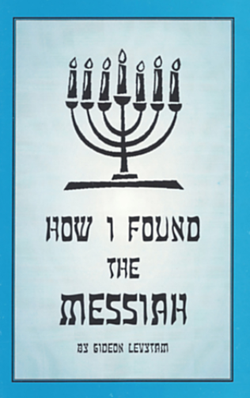
Follow Gideon Levytam's journey and discover how he was led by God, through a series of exciting circumstances, to find the One his people are still waiting for.
Past Episodes

Featured Offer
Follow Gideon Levytam's journey and discover how he was led by God, through a series of exciting circumstances, to find the One his people are still waiting for.
About Holy Scriptures and Israel
As time passed by, the Lord Yeshua took dear brother John Van Stormbroek to himself. The ministry of Holy Scriptures and Israel continued with additional development. In the early 1990’s, a weekly morning Bible class began which brother Gideon Levytam led regularly in the City of Toronto. This weekly open Bible class was held in the Willowdale assembly meeting hall. Eventually, a second mid-week evening Bible class was added. In April 2002, the need for an additional outreach Bible teaching meeting arose. We begun a Saturday (Shabbat) ministry meeting in which a systematic teaching of God’s word is presented to all who attend. Together we learn God’s Word, pray for each need and the salvation of Israel, and sing songs of worship unto our God, praising Him and our Lord Yeshua the Messiah.
In Mid 2004 we started to air on Joy 1250 Radio station a 15 minute Bible teaching program called "The Holy Scriptures and Israel" with Gideon Levytam. The broadcast teaches God’s word from a Hebrew Messianic perspective and has proved to be a blessing to many. It's now aired seven days a week. Our prayer is that many more of our Israeli people will have a clear understanding of who Yeshua is, why we all need him, and come to know him as their Lord and Messiah.
About Gideon Levytam
Contact Holy Scriptures and Israel with Gideon Levytam
426 Simcoe Street
Niagara-on-The-Lake
Ontario L0S 1J0
Canada
(905) 325-1234